

What size mini split do I actually need?
Roughly 20 BTU per square foot is the rule of thumb. Here is what every unit on this site claims against its own capacity — and where the two disagree.
Every figure here is taken from the manufacturer’s published listing and measured against the rest of the group. We do not install or test mini splits. Where a listing is silent, this site prints not stated rather than a plausible default.
What this group looks like
| Measure | Middle half | Median |
|---|---|---|
| Capacity | 12,000 BTU – 21,000 BTU | 12,000 BTU |
| Claimed coverage | 550 sq ft – 750 sq ft | 750 sq ft |
| Sizing check (derived) | — | 16.0 BTU/sq ft |
| SEER2 | 19 – 21 | 19 |
The middle-half column spans the 25th to 75th percentile, so it describes where most of this group sits rather than being pulled about by one unusual unit.
| Class | Listings | Median capacity | Median coverage | BTU/sq ft | Reading |
|---|---|---|---|---|---|
| 9,000 BTU Mini Splits | 8 | 9,000 BTU | — | — | — |
| 12,000 BTU Mini Splits | 43 | 12,000 BTU | 750 sq ft | 16.0 | coverage claim looks optimistic |
| 18,000 BTU Mini Splits | 14 | 18,000 BTU | 1,250 sq ft | 14.4 | coverage claim looks optimistic |
| 24,000 BTU Mini Splits | 14 | 24,000 BTU | 1,250 sq ft | 20.7 | about the rule of thumb |
| 36,000 BTU Mini Splits | 10 | 36,000 BTU | — | — | — |
This is arithmetic, not a load calculation. The sizing check is the unit’s own BTU rating divided by the coverage area it claims, against a rule of thumb of roughly 20 BTU per square foot. It tells you when a listing’s two numbers disagree with each other. It knows nothing about your ceiling height, insulation, window area, climate or which way the room faces — and all of those move the answer. Sizing a system properly is a Manual J calculation and it is a professional’s job.
Against the market as a whole this group claims about as much coverage per BTU as average — a median of 16.0 BTU per square foot against 16.0 overall. Lower means a bolder coverage claim, not a better unit.
What these listings publish
Specification coverage is uneven, and knowing where it runs out is part of shopping honestly.
| Specification | Stated | Share |
|---|---|---|
| Capacity in BTU | 89 | 98% |
| Claimed coverage | 70 | 77% |
| SEER2 | 75 | 82% |
| Noise level | 89 | 98% |
| Circuit voltage | 88 | 97% |
| Refrigerant | 72 | 79% |
What they cost
Bands, not prices — and the equipment is frequently the smaller half of the project once the circuit and the installation are counted.
| Band | Listings | Share |
|---|---|---|
| Under $400 | 9 | 10% |
| $400–700 | 39 | 43% |
| $700–1,200 | 15 | 16% |
| $1,200–2,000 | 19 | 21% |
| Over $2,000 | 9 | 10% |
The rule, and how far to trust it
About 20 BTU per square foot suits a typical room: a 12,000 BTU head for around 600 square feet, 18,000 for around 900. It is a starting point and not an answer, because ceiling height, insulation, window area, orientation and occupancy all move it — sometimes by a third. What it is genuinely good for is catching a listing whose own two numbers disagree with each other.
Oversizing is the failure that hides
An undersized unit runs constantly and never arrives, which you notice in a day. An oversized one cools fast, shuts off, and repeats — never running long enough to dehumidify. The room ends up cold and clammy rather than comfortable, and the compressor wears faster for the extra starts. Nothing looks broken, so it goes undiagnosed for years. Bigger is not safer.
Where the classes diverge
Read the table above across its rows. The 24,000 BTU class sits almost exactly on the rule of thumb. The 18,000 BTU class claims coverage that works out well below it — those square footages assume a well-insulated room in a moderate climate, and a hot or leaky one will not get them. That is not a defect in the units; it is a difference in how boldly the coverage is claimed, and it is invisible unless you do the division.
What this cannot do
It knows nothing about your room. A Manual J load calculation is what actually sizes a system, it accounts for everything listed above, and it is a professional’s job. This page tells you which listings are making claims their own specifications do not support, which is a different and smaller thing.
What the manufacturer’s coverage figure is worth
Most listings state a square footage, and across this corpus those claims work out at roughly 16 BTU per square foot — below the rule of thumb this page starts from. The listed coverage is best read as the largest room the unit could serve under favourable conditions rather than the room it should be specified for. Sizing from the manufacturer’s own number is the most common route to a correctly working unit that never quite keeps up.
The variables a rule of thumb ignores
Square footage is a proxy for what actually matters, which is how much heat enters the room and how quickly. Ceiling height changes the volume, glazing changes the gain enormously, orientation decides when that gain arrives, and insulation and air leakage decide how much of it stays. Two rooms of identical floor area can differ by a factor of two in what they need, which is why the rule of thumb is a filter for implausible listings rather than a specification method.
Where the two published numbers disagree with each other
Some listings state both a capacity and a coverage area, and dividing one by the other is the quickest test of whether a claim is plausible. Where the result sits far below the rule of thumb, the listing is claiming a room size its own capacity does not support under ordinary conditions. That is not proof the unit is poor — it is proof the coverage figure is optimistic, and it is visible without knowing anything about your room.
Getting it wrong in the smaller direction
An undersized unit announces itself within a day: it runs continuously, never quite reaches the set temperature, and is obviously inadequate on the hottest afternoon. That visibility is why undersizing is the rarer mistake and the less costly one — it is diagnosed immediately and the remedy is known. Oversizing hides for years behind a room that is merely a bit clammy, which is why this page keeps returning to it.
Before you buy
Do not size up “to be safe”
An oversized unit short-cycles, never dehumidifies, and leaves the room cold and clammy while looking perfectly functional. Where the arithmetic puts you between two sizes, insulation and window area decide — and a load calculation decides properly.
Price the circuit, not just the box
A 230 V unit needs a dedicated run from the panel, and on a long route that can cost more than the difference between any two units here.
Treat marketing language as a claim
“Whole home”, “ultra quiet” and a square footage on a box are positioning. Look for the number behind each: a BTU rating, a decibel figure, a SEER2 value. Where this site could not find one, it says not stated.
Compare them
The finder below is already filtered to this group. Every result carries its sizing check.
91 mini splits match

Daikin 24,000 BTU (9K + 12K + 12K) 21SEER2 3-Zone Mini Split Heat Pump
- Sizing check
- 15.3BTU/sq ft
- Capacity
- 23000BTU
- SEER2
- 21.0
- Noise
- 24dB
- Circuit
- 230 V
- Refrigerant
- R-32
Rated for
1,500sq ft
24,000 BTU · 1,000 sq ft and up · 15 mini splits
SEER2 efficiency
21.0SEER2
+11% vs the 19.0 median — more efficient than most in its class
Rated area is +20% against the class median of 1,250.

Albott Mini Split AC/Heating System, 20,000 BTU ODU, 25 SEER2 2 Zone 9K+12K BTU Ductless Inverter Heat Pump, WiFi Enabled with Pre-Charged Condenser & 16.4 Ft Line Set, 208-230V, Energy-Efficient
- Sizing check
- 22.1BTU/sq ft
- Capacity
- 21000BTU
- SEER2
- 25.0
- Noise
- 29dB
- Circuit
- 230 V
- Refrigerant
- R-32
Rated for
950sq ft
24,000 BTU · 750 – 1,000 sq ft · 30 mini splits
SEER2 efficiency
25.0SEER2
+32% vs the 19.0 median — more efficient than most in its class
Rated area is +27% against the class median of 750.

DELLA 20K BTU Dual Zone Mini Split AC (9K+18K), 19 SEER2, 16ft Kits
- Sizing check
- 14.3BTU/sq ft
- Capacity
- 20000BTU
- SEER2
- 19.0
- Noise
- 49dB
- Circuit
- 230 V
- Refrigerant
- R-454B
Rated for
1,400sq ft
24,000 BTU · 1,000 sq ft and up · 15 mini splits
SEER2 efficiency
19.0SEER2
0% vs the 19.0 median — typical for its class
Rated area is +12% against the class median of 1,250.

COSTWAY 18,000 BTU Mini Split Air Conditioner, Energy Star
- Sizing check
- 14.4BTU/sq ft
- Capacity
- 18000BTU
- SEER2
- 21.0
- Noise
- 23dB
- Circuit
- 230 V
- Refrigerant
- R-32
Rated for
1,250sq ft
18,000 BTU · 1,000 sq ft and up · 15 mini splits
SEER2 efficiency
21.0SEER2
+11% vs the 19.0 median — more efficient than most in its class
Rated area is 0% against the class median of 1,250.
Albott 2 Zone Mini Split AC/Heating System, 12K+12K BTU 25 SEER2
- Sizing check
- 21.8BTU/sq ft
- Capacity
- 24000BTU
- SEER2
- 25.0
- Noise
- 29dB
- Circuit
- 230 V
- Refrigerant
- R-32
Rated for
1,100sq ft
24,000 BTU · 1,000 sq ft and up · 15 mini splits
SEER2 efficiency
25.0SEER2
+32% vs the 19.0 median — more efficient than most in its class
Rated area is -12% against the class median of 1,250.

ROVSUN 28000 BTU Tri Zone Mini Split AC/Heating System, 20 SEER2 3 Zone (9K/9K/9K) BTU Ductless Split Air Conditioner with Pre-Charged Condenser, Heat Pump & 25Ft Line Set, 208-230V
- Sizing check
- 37.3BTU/sq ft
- Capacity
- 28000BTU
- SEER2
- 20.0
- Noise
- 41dB
- Circuit
- 230 V
- Refrigerant
- R-32
Rated for
750sq ft
24,000 BTU · 750 – 1,000 sq ft · 30 mini splits
SEER2 efficiency
20.0SEER2
+5% vs the 19.0 median — typical for its class
Rated area is 0% against the class median of 750.
COSTWAY 12,000 BTU Mini Split Air Conditioner, with Heat Pump
- Sizing check
- 16.0BTU/sq ft
- Capacity
- 12000BTU
- SEER2
- 21.0
- Noise
- 23dB
- Circuit
- 230 V
- Refrigerant
- R-32
Rated for
750sq ft
12,000 BTU · 750 – 1,000 sq ft · 30 mini splits
SEER2 efficiency
21.0SEER2
+11% vs the 19.0 median — more efficient than most in its class
Rated area is 0% against the class median of 750.

DELLA Vario Series 12000 BTU Mini Split Air Conditioner Work with Alexa with 1 Ton Pre-Charged Heat Pump Ductless Inverter System, 23 SEER2, Cools Up to 550 Sq. Ft,16.4ft Installation Kit Included
- Sizing check
- 21.8BTU/sq ft
- Capacity
- 12000BTU
- SEER2
- 23.0
- Noise
- 52dB
- Circuit
- 230 V
- Refrigerant
- R-454B
Rated for
550sq ft
12,000 BTU · 500 – 750 sq ft · 17 mini splits
SEER2 efficiency
23.0SEER2
+15% vs the 20.0 median — more efficient than most in its class
Rated area is 0% against the class median of 550.
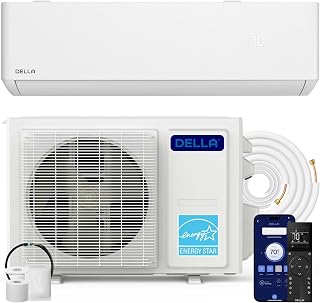
DELLA Hyper Heat Lower as -13℉ 12,000 BTU WiFi Mini Split,Work with Alexa,Energy Star 115V 23 SEER2,Cools Up to 550 Sq. Ft,Inverter AC with 1 Ton Pre-Charged Heat Pump & 16.4ft Installation Kits
- Sizing check
- 21.8BTU/sq ft
- Capacity
- 12000BTU
- SEER2
- 23.0
- Noise
- 27dB
- Circuit
- 115 V
- Refrigerant
- R-454B
Rated for
550sq ft
12,000 BTU · 500 – 750 sq ft · 17 mini splits
SEER2 efficiency
23.0SEER2
+15% vs the 20.0 median — more efficient than most in its class
Rated area is 0% against the class median of 550.

Daikin 12,000 BTU 18 SEER2 Entra R32 Series Heat Pump Mini Split A/C
- Sizing check
- 21.8BTU/sq ft
- Capacity
- 12000BTU
- SEER2
- 18.0
- Noise
- 31dB
- Circuit
- 230 V
- Refrigerant
- R-32
Rated for
550sq ft
12,000 BTU · 500 – 750 sq ft · 17 mini splits
SEER2 efficiency
18.0SEER2
-10% vs the 20.0 median — less efficient than most in its class
Rated area is 0% against the class median of 550.

DELLA 35K BTU 4 Zone Mini Split AC (3x9K+12K), 19 SEER2, 16ft Kits
- Sizing check
- 20.0BTU/sq ft
- Capacity
- 35000BTU
- SEER2
- 19.0
- Noise
- 29dB
- Circuit
- 230 V
- Refrigerant
- R-454B
Rated for
1,750sq ft
36,000 BTU · 1,000 sq ft and up · 15 mini splits
SEER2 efficiency
19.0SEER2
0% vs the 19.0 median — typical for its class
Rated area is +40% against the class median of 1,250.

DELLA 28K BTU ODU Mini Split AC 3 Zone (2 * 9K+12K BTU) 20 SEER2 208-230V Works with Alexa and Wifi, Cools Up to 1350 Sq.Ft, Energy Efficient, Multi Zone, Pre-Charged Heat Pump, 16ft Kits
- Sizing check
- 20.7BTU/sq ft
- Capacity
- 28000BTU
- SEER2
- 20.0
- Noise
- 41dB
- Circuit
- 230 V
- Refrigerant
- R-454B
Rated for
1,350sq ft
24,000 BTU · 1,000 sq ft and up · 15 mini splits
SEER2 efficiency
20.0SEER2
+5% vs the 19.0 median — typical for its class
Rated area is +8% against the class median of 1,250.
Related
- The full mini split finder — unfiltered, every class.
- How we compile these figures.