
DELLA 35K BTU 4 Zone Mini Split AC (3x9K+12K): sizing, circuit and what the listing claims
A 35,000 BTU cooling-only head, measured against the 10 units in the 36,000 BTU class — including whether its own coverage claim and its own BTU rating agree with each other.

Every figure below is read from the manufacturer’s own listing. We do not install mini splits, nobody here holds an HVAC licence, and nothing on this page has been measured in a room. Where the listing is silent, this page prints not stated rather than a plausible default, and the one figure that is not on any listing — whether its two headline numbers agree — is arithmetic on the numbers that are, shown with its working.
At a glance
| Specification | Stated |
|---|---|
| Capacity | 35,000 BTU |
| Coverage claimed | 1,750 sq ft |
| Sizing check (derived) | 20.0 BTU/sq ft |
| SEER2 | 19 |
| Indoor noise | 29 dB |
| Supply voltage | 230 V |
| Circuit | dedicated circuit required |
| Refrigerant | R-454B |
| Zones | multi-zone |
| Price band | Over $2,000 |
| Brand | Della |
Do its own two numbers agree?
Every mini-split listing publishes a capacity and a coverage area, and the two are frequently written by different people. Divide one by the other and this unit works out at 20.0 BTU per square foot — about the rule of thumb. The listing’s two numbers agree with each other and with the usual 20 BTU per square foot, which is the most that can be said for a coverage claim from here: it is internally consistent. That is not the same as being right for your room, but a listing whose own figures contradict each other cannot be right for anybody’s.
One thing shifts the reading here: this is a multi-zone system, so the 35,000 BTU is divided between several indoor heads rather than delivered into one room. Each head is sized for its own space, and the coverage figure covers all of them together. That tends to push the aggregate ratio upward without the system being oversized for any individual room — so on a multi-zone listing this check is a weaker signal than it is on a single head, and the per-room sizing is the question that actually matters.
This is arithmetic, not a load calculation. The sizing check is the unit’s own BTU rating divided by the coverage area it claims, against a rule of thumb of roughly 20 BTU per square foot. It tells you when a listing’s two numbers disagree with each other. It knows nothing about your ceiling height, insulation, window area, climate or which way the room faces — and all of those move the answer. Sizing a system properly is a Manual J calculation and it is a professional’s job.
The circuit this one needs
At 230 V this is a 230 V unit, and the listing states it requires a dedicated circuit. That distinction decides a larger share of the installed cost than any other specification here. A 230 V unit needs a run from the panel, and on a panel with nothing spare that is the start of a much larger job. It is the same conversation an EV charger starts, and it is worth having before the unit is ordered rather than after it has arrived.
Neither figure tells you what the installation will cost, because that is decided by the line-set run, the wall penetration and what your panel can spare — none of which appears on any listing.
How it compares with its own class
Against the 10 units in the 36,000 BTU class, rather than against a generic alternative:
| Measure | This one | Class median | Where it sits |
|---|---|---|---|
| Coverage claimed | 1,750 sq ft | 1,750 sq ft | the same as the class median |
| Sizing check (derived) | 20.0 BTU/sq ft | 75.0 BTU/sq ft | below the class median of 75 BTU/sq ft |
| SEER2 | 19 | 20 | below the class median of 20 |
| Indoor noise | 29 dB | 29 dB | the same as the class median |
A unit on the class median is not a worse buy than one above it. Within a single capacity class the units are, by construction, all rated to move the same amount of heat — what separates them is efficiency, noise, what the listing claims about coverage, and what the installation will involve. SEER2 above the median costs more to buy and less to run, and which of those matters depends on how many hours a year the unit will actually work.
Where it suits
- A room of roughly 1,750 sq ft at the usual rule of thumb — a starting point for a conversation with an installer, not a substitute for one.
- Cooling only. This listing does not claim heating, so a room that needs winter heat needs something else as well.
- A bedroom or a study: at 29 dB the indoor head is quiet enough to sleep beside.
- More than one room from a single outdoor unit, which is what multi-zone is for.
- A system you expect to keep for years, on R-454B rather than the R-410A being phased down.
Where it does not
- A panel with nothing spare, since a 230 V unit needs its own run and an older service frequently cannot give it one without an upgrade.
- Sharing a circuit with anything else. The listing states a dedicated circuit, and that is not a preference.
- Any room where winter heat is part of the requirement.
- A DIY installation. This listing claims no pre-charged line set, so it needs a licensed technician to vacuum and charge the system.
What the listing claims
These are the manufacturer’s statements, not findings. Nothing on this page has been measured by anyone here, and a specification stated on a listing is a claim until the unit is in front of you.
It states capacity, coverage claimed, sizing check, SEER2, indoor noise, supply voltage. It does not state whether the line set arrives pre-charged.
The gaps matter as much as the figures. A listing that omits a SEER2 rating is not describing an inefficient unit, it is describing itself incompletely — and SEER2 is the specification that decides what the unit costs to run for the fifteen years after the invoice is paid, which is the larger number by some distance.
What no listing on this site tells you
Three things decide whether a mini split is the right one, and none of them is a specification any manufacturer publishes. The first is the actual heat load of the room, which is a property of your house rather than of the unit. Ceiling height, insulation, how much glass there is and which way it faces can move the answer by half again in either direction, and the rule of thumb this page uses knows none of them. Sizing a system properly is a Manual J calculation and it is a professional’s job; every figure here is a way of checking whether a listing contradicts itself, not a way of skipping that.
The second is the line set — the refrigerant pipes between the indoor head and the outdoor unit. Its length, how far it has to rise, and whether the route is through a finished wall decide a large part of the installed cost, and none of it is on the listing. This listing makes no pre-charged claim, so the system needs vacuuming and charging on site by someone licensed to handle refrigerant.
The third is what happens after the install. Who services it, whether the warranty survives a DIY installation — many do not — and whether the refrigerant it uses will still be straightforward to buy in ten years. This one uses R-454B. R-410A is being phased down under current rules, which does not make an R-410A system a bad buy today but does make servicing it a question worth asking now rather than later.
Before you decide
Check the listing against itself first
This one claims 35,000 BTU and 1,750 sq ft, which is 20.0 BTU per square foot. A listing whose own two numbers disagree is the cheapest warning sign available, and it costs nothing to look for.
Settle the circuit before the unit
At 230 V this is a 230 V unit and the listing states it needs a dedicated circuit. Whether your panel can feed it is a question for an electrician and a load calculation, and it is much cheaper asked before the unit arrives.
Treat marketing language as a claim
Where a phrase on the listing matters to your decision, look for the number behind it: a stated SEER2 rather than a sentence about efficiency, a stated decibel figure rather than a promise of quiet. Where this site could not find that number, it says not stated.
If the sizing is in the right region and the circuit is available, the current price and availability are on Amazon — this site deliberately does not quote either, because both are stale within days of being read.
Check current price and availability
Compare it against the rest of its class
The finder below is filtered to the 36,000 BTU class. Every result shows its sizing check and is measured against the median for that class.
10 mini splits match
DELLA 35K BTU 4 Zone Mini Split AC (3x9K+12K), 19 SEER2, 16ft Kits
- Sizing check
- 20.0BTU/sq ft
- Capacity
- 35000BTU
- SEER2
- 19.0
- Noise
- 29dB
- Circuit
- 230 V
- Refrigerant
- R-454B
Rated for
1,750sq ft
36,000 BTU · 1,000 sq ft and up · 15 mini splits
SEER2 efficiency
19.0SEER2
0% vs the 19.0 median — typical for its class
Rated area is +40% against the class median of 1,250.

ROVSUN 38000 BTU Quad Zone WIFI Mini Split AC/Heating System, 20 SEER2 4 Zone (9K/9K/9K/9K) BTU Ductless Split Air Conditioner with Pre-Charged Condenser, Heat Pump & 25Ft Line Set, 208-230V
- Sizing check
- not stated
- Capacity
- 38000BTU
- SEER2
- 20.0
- Noise
- 35dB
- Circuit
- 230 V
- Refrigerant
- R-32
Rated for
Not stated
This listing does not publish a figure, so it cannot be placed against the baseline.
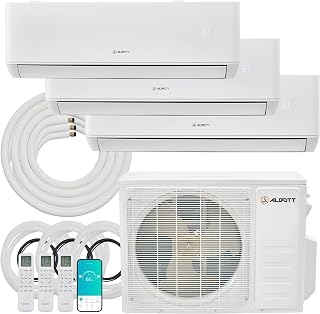
Albott 3 Zone Mini Split AC/Heating System, 9K+9K+12K BTU, 22 SEER2
- Sizing check
- 75.0BTU/sq ft
- Capacity
- 30000BTU
- SEER2
- 22.0
- Noise
- 29dB
- Circuit
- 230 V
- Refrigerant
- not stated
Rated for
400sq ft
36,000 BTU · up to 500 sq ft · 8 mini splits
SEER2 efficiency
22.0SEER2
No class baseline to compare against.
Rated area is -11% against the class median of 450.

DELLA 35K BTU 4 Zone Mini Split AC (3x9K+18K), 19 SEER2, 16ft Kits
- Sizing check
- not stated
- Capacity
- 35000BTU
- SEER2
- 19.0
- Noise
- 29dB
- Circuit
- 230 V
- Refrigerant
- R-454B
Rated for
Not stated
This listing does not publish a figure, so it cannot be placed against the baseline.

COSTWAY 30k Quad 4 Zone Mini Split Air Conditioner
- Sizing check
- not stated
- Capacity
- 30000BTU
- SEER2
- 23.0
- Noise
- 30dB
- Circuit
- not stated
- Refrigerant
- R-32
Rated for
Not stated
This listing does not publish a figure, so it cannot be placed against the baseline.

YITAHOME 36000 BTU Mini Split AC/Heating System 19 SEER2 18000 BTU * 2 Set
- Sizing check
- not stated
- Capacity
- 36000BTU
- SEER2
- 19.0
- Noise
- 25dB
- Circuit
- 230 V
- Refrigerant
- R-32
Rated for
Not stated
This listing does not publish a figure, so it cannot be placed against the baseline.

YITAHOME 36000 BTU Mini Split AC/Heating System 17.5 SEER2 12000 BTU*3 Set
- Sizing check
- not stated
- Capacity
- 36000BTU
- SEER2
- 17.5
- Noise
- 25dB
- Circuit
- 230 V
- Refrigerant
- R-32
Rated for
Not stated
This listing does not publish a figure, so it cannot be placed against the baseline.

YITAHOME 48000 BTU Mini Split AC/Heating System 20 SEER2 12000 BTU * 4 Set
- Sizing check
- not stated
- Capacity
- 48000BTU
- SEER2
- 20.0
- Noise
- 25dB
- Circuit
- 115 V
- Refrigerant
- R-32
Rated for
Not stated
This listing does not publish a figure, so it cannot be placed against the baseline.

Senville Mini Split AC/Heating System, 5 Zone, White, 48000 BTU
- Sizing check
- not stated
- Capacity
- 48000BTU
- SEER2
- not stated
- Noise
- 24dB
- Circuit
- 230 V
- Refrigerant
- R-410A
Rated for
Not stated
This listing does not publish a figure, so it cannot be placed against the baseline.

YITAHOME 48000 BTU Mini Split AC/Heating System, 4×12000 Single-Zone Sets
- Sizing check
- not stated
- Capacity
- 48000BTU
- SEER2
- not stated
- Noise
- 25dB
- Circuit
- 115 V
- Refrigerant
- R-32
Rated for
Not stated
This listing does not publish a figure, so it cannot be placed against the baseline.
Related
- 36,000 BTU Mini Splits — the full class, with baselines for every specification.
- What size mini split do I need? — the arithmetic, and where it stops helping.
- The full mini split finder — unfiltered, every capacity.
- How we compile these figures.