
Mini split guides, one page per model
Every unit here has been measured against the median for its own capacity class, and every one is checked against its own coverage claim — the arithmetic the listing leaves for you to do.
These pages exist because a specification means little on its own. A 12,000 BTU head is not simply smaller than an 18,000 BTU one; whether it is the right size depends on a room this site cannot see, and the most useful thing that can be said from here is whether the listing’s own two numbers — the capacity and the coverage it advertises — agree with each other. Frequently they do not.
We do not install mini splits and nobody here holds an HVAC licence. Every figure is read from the manufacturer’s listing, the sizing check is arithmetic on two figures the same listing publishes, and where a listing is silent the page says not stated.
All 32 guides
9,000 BTU Mini Splits
| Unit | Capacity | Coverage claimed | BTU/sq ft |
|---|---|---|---|
 ROVSUN 9000 BTU Mini Split ROVSUN 9000 BTU Mini Split |
9,000 BTU | 450 sq ft | 20.0 |
 Mountman 9000 BTU Mini Split Mountman 9000 BTU Mini Split |
9,000 BTU | 450 sq ft | 20.0 |
 Rellytech Mini Split AC/Heating Rellytech Mini Split AC/Heating |
9,000 BTU | 450 sq ft | 20.0 |
 Senville LETO Mini Split Air Senville LETO Mini Split Air |
9,000 BTU | 400 sq ft | 22.5 |
 COSTWAY 9000BTU Mini Split Air COSTWAY 9000BTU Mini Split Air |
9,000 BTU | 450 sq ft | 20.0 |
 9000 BTU Mini Split AC & Heating 9000 BTU Mini Split AC & Heating |
9,000 BTU | 450 sq ft | 20.0 |
12,000 BTU Mini Splits
| Unit | Capacity | Coverage claimed | BTU/sq ft |
|---|---|---|---|
 DELLA Vario Series 12000 BTU Mini DELLA Vario Series 12000 BTU Mini |
12,000 BTU | 550 sq ft | 21.8 |
| DELLA Vario Series 12000 BTU Mini |
12,000 BTU | 550 sq ft | 21.8 |
 Albott Easy DIY Series Albott Easy DIY Series |
12,000 BTU | 750 sq ft | 16.0 |
 Albott Easy DIY Series Albott Easy DIY Series |
12,000 BTU | 750 sq ft | 16.0 |
 12000 BTU Mini Split Air 12000 BTU Mini Split Air |
12,000 BTU | 750 sq ft | 16.0 |
| Senville LETO Mini Split Air |
12,000 BTU | 700 sq ft | 17.1 |
| Senville LETO Mini Split Air |
12,000 BTU | 700 sq ft | 17.1 |
18,000 BTU Mini Splits
| Unit | Capacity | Coverage claimed | BTU/sq ft |
|---|---|---|---|
 DELLA Motto Series 18000 BTU 19 DELLA Motto Series 18000 BTU 19 |
18,000 BTU | 1,000 sq ft | 18.0 |
 18000BTU Mini Split Air Conditioner 18000BTU Mini Split Air Conditioner |
18,000 BTU | 1,250 sq ft | 14.4 |
 Daikin Daikin |
18,000 BTU | 1,000 sq ft | 18.0 |
 COSTWAY COSTWAY |
18,000 BTU | 1,250 sq ft | 14.4 |
 Wifi Enabled Wifi Enabled |
18,000 BTU | 1,250 sq ft | 14.4 |
 YITAHOME 21 SEER2 18000 BTU Mini YITAHOME 21 SEER2 18000 BTU Mini |
18,000 BTU | 1,250 sq ft | 14.4 |
| Rellytech Mini Split AC/Heating |
18,000 BTU | 1,250 sq ft | 14.4 |
24,000 BTU Mini Splits
| Unit | Capacity | Coverage claimed | BTU/sq ft |
|---|---|---|---|
 ROVSUN 28000 BTU Tri Zone Mini ROVSUN 28000 BTU Tri Zone Mini |
28,000 BTU | 750 sq ft | 37.3 |
 DELLA 28K BTU ODU Mini Split AC 3 DELLA 28K BTU ODU Mini Split AC 3 |
28,000 BTU | 1,350 sq ft | 20.7 |
 Albott Mini Split AC/Heating Albott Mini Split AC/Heating |
21,000 BTU | 950 sq ft | 22.1 |
 Daikin Daikin |
23,000 BTU | 1,500 sq ft | 15.3 |
 YITAHOME 23 SEER2 24K BTU 3 Zone YITAHOME 23 SEER2 24K BTU 3 Zone |
24,000 BTU | 1,200 sq ft | 20.0 |
 DELLA 20K BTU Dual Zone Mini Split DELLA 20K BTU Dual Zone Mini Split |
20,000 BTU | 1,400 sq ft | 14.3 |
| Albott 2 Zone Mini Split AC/Heating |
24,000 BTU | 1,100 sq ft | 21.8 |
| Senville LETO Mini Split Air |
24,000 BTU | 1,250 sq ft | 19.2 |
 Cooper & Hunter Cooper & Hunter |
24,000 BTU | 600 sq ft | 40.0 |
36,000 BTU Mini Splits
| Unit | Capacity | Coverage claimed | BTU/sq ft |
|---|---|---|---|
 DELLA 35K BTU 4 Zone Mini Split AC DELLA 35K BTU 4 Zone Mini Split AC |
35,000 BTU | 1,750 sq ft | 20.0 |
 ROVSUN 38000 BTU Quad Zone WIFI ROVSUN 38000 BTU Quad Zone WIFI |
38,000 BTU | — | — |
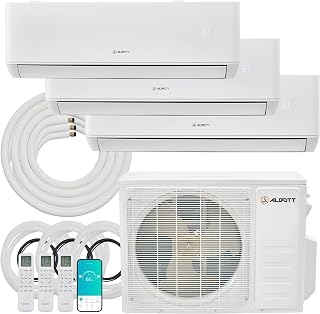 Albott 3 Zone Mini Split AC/Heating Albott 3 Zone Mini Split AC/Heating |
30,000 BTU | 400 sq ft | 75.0 |
What is in each guide
The same six things, in the same order, so two guides can be read against each other without hunting for the figure that moved. First, everything the listing publishes, in one table — capacity, claimed coverage, SEER2, indoor noise, supply voltage, circuit type, refrigerant, and whether it heats as well as cools. Alongside them sits the figure that is not on any listing: the BTU per square foot its own two headline numbers imply.
Second, that check worked out in the open, against a rule of thumb of roughly 20 BTU per square foot. This is the section these pages exist for, and it is also the section that is easiest to overstate, so it is bounded explicitly: it tells you when a seller’s two numbers contradict each other, and it tells you nothing whatsoever about your ceiling height, your insulation or your climate.
Third, the circuit. A 115 V unit can frequently use a circuit that already exists; a 230 V unit needs a run from the panel, and on a panel with nothing spare that is the start of a much larger job. Both voltages are stated on almost every listing and the consequence is stated on none of them.
Fourth and fifth, the conditions under which the unit suits and the conditions under which it does not — both derived from published specifications rather than from an opinion. Sixth, what the listing claims and, as importantly, what it leaves out.
What these guides are not
They are not reviews. Nothing here has been mounted, charged, or run through a summer, and no unit on this site has been assessed by anyone holding an HVAC licence. There is no score, no ranking and no best buy, because none of those can be produced honestly from listing text alone. What can be produced honestly is a comparison against every other listing in the same class, and that is what these pages are.
They are emphatically not a sizing service. The check on every guide divides one published number by another and compares the result with a rule of thumb; a real answer comes from a Manual J calculation that accounts for the building, and that is a professional’s job. Using these pages to pick a capacity would be using them for the one thing they are careful to say they cannot do.
They are also not a substitute for the class pages. If you are still deciding between 12,000 and 18,000 BTU, the class comparison is the better starting point — it shows the whole distribution rather than one point in it. These guides are for the stage after that, when the decision has narrowed to a particular unit.
Which units get a guide, and which do not
Not every listing in the corpus can carry one. A guide is worth writing only where the listing publishes enough to compare — eight or more of the figures these pages show — and a listing that states a BTU rating and little else produces a page that is mostly the words not stated. Those units are still in the finder and still counted in every class median on this site; they simply do not get a page of their own, because there would be nothing on it.
The corpus behind all of this holds 91 units. Coverage across them is better than on most of this network: a capacity figure appears on virtually every listing, as do an indoor noise figure, a supply voltage and a circuit type. A claimed coverage area appears on about three quarters, which is the figure that decides whether a guide can carry its sizing check at all, and a SEER2 rating on about four fifths. A unit that documents itself well is not thereby a better unit, but it is one you can make an informed decision about, and the difference between those two things is most of what this site exists to show.
Prefer to compare a whole class?
- 9,000 BTU Mini Splits — the full class, with baselines for every specification.
- 12,000 BTU Mini Splits — the full class, with baselines for every specification.
- 18,000 BTU Mini Splits — the full class, with baselines for every specification.
- 24,000 BTU Mini Splits — the full class, with baselines for every specification.
- 36,000 BTU Mini Splits — the full class, with baselines for every specification.
- The full mini split finder — unfiltered, every capacity.
- What size mini split do I need? — the arithmetic, and where it stops helping.